Stop! Harper time!
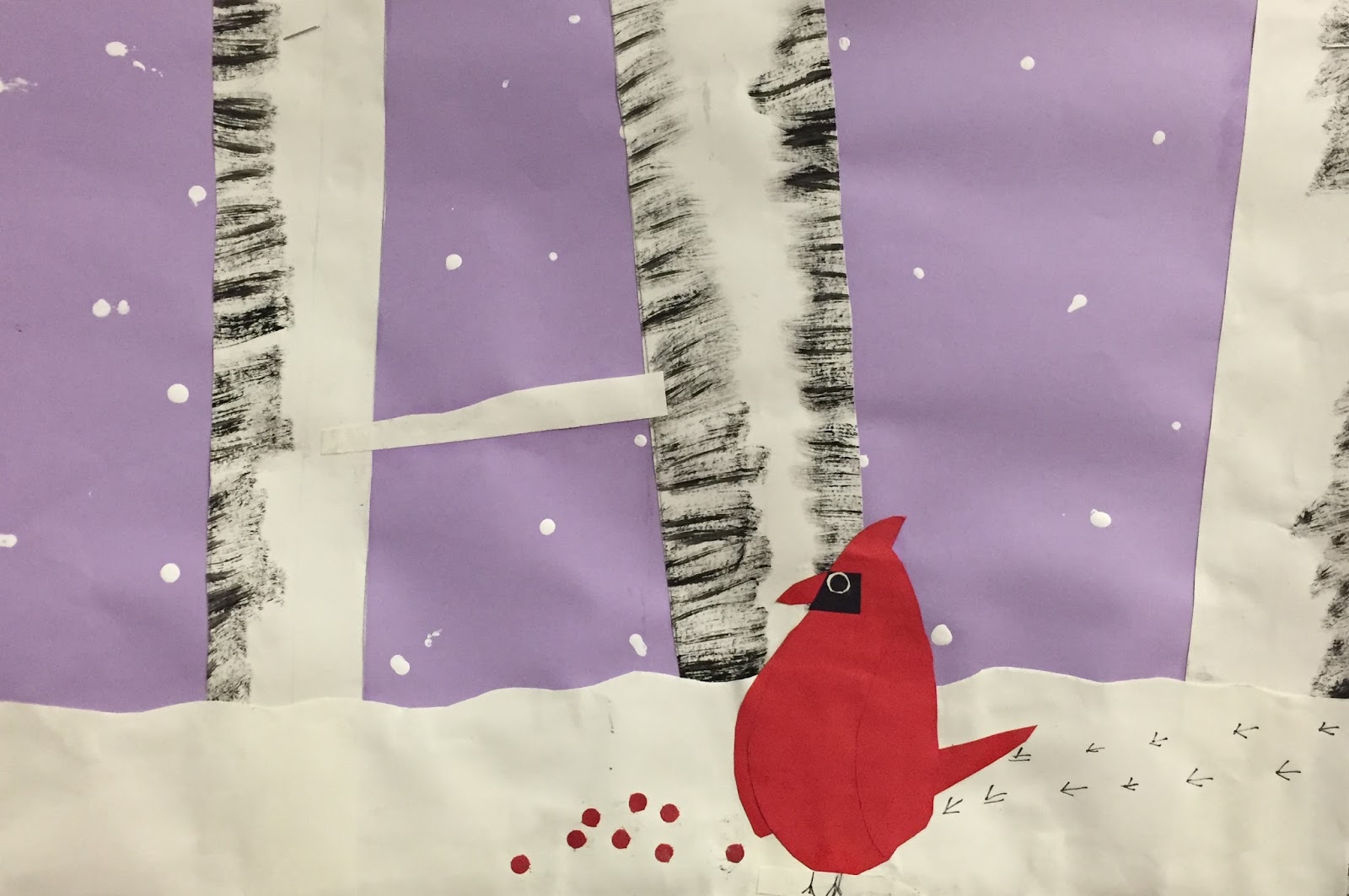
Wow. That was super lame. It did make me chuckle, though. It's also true. Right before winter break is when I typically have my 3rd graders study the work of Charley Harper. The outcome is a lesson that forces students to think and create art in a new way. It also looks pretty wintery and makes for a great display.
This lesson is all about Charley Harper, an artist who lived in Ohio the majority of his life. If you're familiar with his work, you know that he uses flat, graphic shapes to create mainly images of wildlife. As my school is in Ohio, I have students all make cardinals. I don't like limiting a project that much, but it works out in this case for a couple of reasons. First, there are limitless ways to create a cardinal out of flat, graphic shapes. No two students create identical cardinals. It also gives me the opportunity to display quite a few reference pictures, so students can get a really good grasp on what they are creating.
I have students start with about 30 minutes of small sketches. I usually have students draw quite a bit before they begin a final project and it results in more thoughtful work. Students then select their favorite sketch and use construction paper to recreate it. They then create a background. More choice is included in making the background. I demonstrate how to make trees (using a dry brush technique), how to make snowflakes (using white paint and the handle of a brush), snow drifts, berries, and bird footprints. Students chose to use any or all of those ideas to make their own background. As has been the case before, the results of this lesson are super successful.
Download the lesson plan for this project here!
This blogging community is full of super cool people with amazing ideas and lesson plans. Often times, I'll find an idea that is interesting and change it or add to it to suit my student population. It is beyond rare that I find a lesson that I duplicate outright. I've done just that with this project.
I take absolutely no credit for this lesson. All the props go to Mrs. Knight at Mrs. Knight's Smartest Artists. This post popped up in my Pinterest feed and I immediately repined it to use this year.
The project is all about the secret underground lives of ants. What goes on in their maze of subterranean tunnels? What if ants were more like us? My students immediately latched on to this project. We initially got all up in the science and talked about ant body parts and habitats. Next, we discussed personification in the illustrations of Beatrix Potter and others. Next, we got to the art.
My students and I had a blast brainstorming about all of the incredible things that could be happening underground. In the end, my second graders produced some highly creative artwork that we were all proud of.
Download my version of the lesson plan!
2013-14 has been the school year of new projects for me. One of my goals this year was to do at least one new lesson with each grade level. I think I've even been able to get in a couple new projects with most grades. Another goal was to get a good printmaking lesson written for all five grade levels. (Look for my upcoming presentation about elementary printmaking curriculum at the Art of Ed Online Summer Conference!!!) This was one of those two birds with one stone type of lessons.
The whole project was inspired by the artwork of Wayne Thiebaud. Of course we all know he painted all kinds of delicious looking food. First graders immediately connect to this. We talked about why people make artwork and how different people have different reasons they create art.
I was able to connect Thiebaud to printmaking simply because the gumballs were a perfect way of introducing printmaking to my first graders. I took about 30 regular plastic soda caps and hot glued little circles of foam to the top of them. Kids were able to apply tempera paint to the foam circles with a brush, then print circles to their heart's content. The rest of the project was simply made out of construction paper. I was really happy with the results!
Download the lesson plan here!
This project has been finished for a while, but I'm just now getting around to posting it. It's a project that I've been doing for several years and there are other examples of it on my blog. I do this one a month or two into the year because it is a great way to have students practice multiple skills. This involves design, painting, coloring, cutting, and gluing. A big part of my first several projects in first grade is simply getting the students used to tools, materials, and procedures that they'll be using in the art room.
My favorite part of this project is the spaceships that the students make. They come up with some really unique ideas. I usually post the lesson plan, but this is so simple that I'll just list the steps here.
- Check out cool pictures of spaceships and watch an awesome space shuttle launch.
- Each student uses construction paper to create a space ship.
- On 12x18 paper, students draw at least three planets and color them using crayons or colored pencils.
- The "space" part is painted with black tempera.
- Stars are painted on using the handle end of a paintbrush.
- The spaceship is glued on to finish.
There are activities that I'm sure carry over to all kids in all art classes throughout the entire world. One of those things is that first graders go absolutely NUTS for oil pastel resist with watercolor. I'm absolutely certain of it.To a first grader pastel resist is some form of magic. That's pretty cool to me.
This project is based on the book Monsters Don't Eat Broccoli by Barbara Jean Hicks. Obviously we all know that monsters don't eat broccoli. It's a well-documented fact.
For this project, my students created a oil pastel resist city background and a monster on a separate piece of construction paper. We added some cool textures/patterns with some simple printmaking with caps and pieces of cardboard. The last step was for students to pick out which food they like the least and make it with construction paper. It was pretty interesting and funny to see what first graders don't like to eat.
Check out the lesson plan here!