Instagram

Showing posts with label science curriculum. Show all posts

Tuesday, June 16, 2015

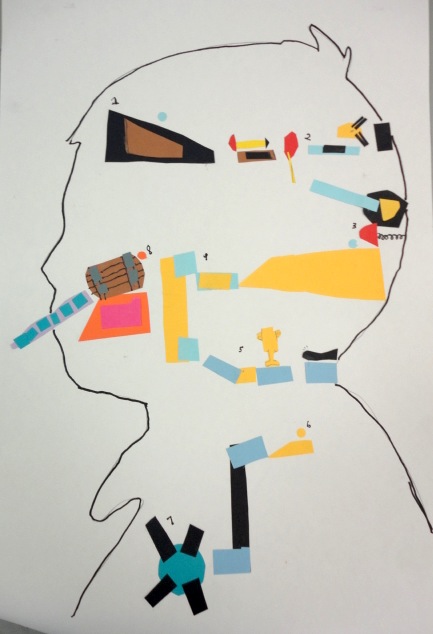
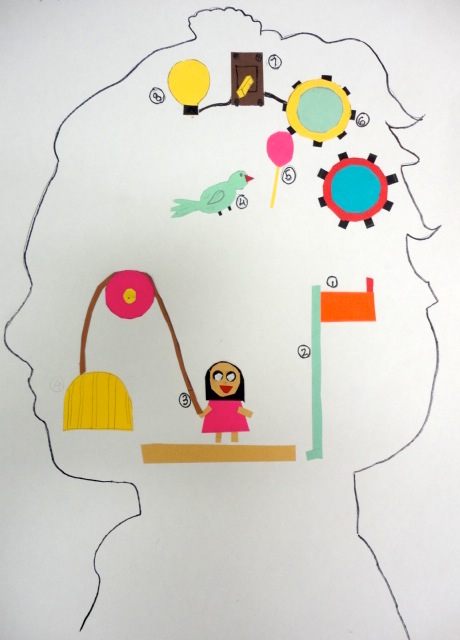
3rd Grade Machine Brains

Think about the game of Mousetrap. Do you actually know how to play it? NOBODY DOES. It's a fact that not a single child in the history of kids has ever played Mousetrap by the rules. You build the whole trap and play with it until you get it just right. When you get bored, you get a snack and move on to another activity. 

This lesson takes the essence of Mousetrap and turns it into a sweet art project. The entire project is based on the cartoon drawings of Rube Goldberg. If you're not familiar with him, he was a cartoonist who is most famous for his sequential "machines" that were created to intentionally make a simple action incredibly complex. 
My students are tasked with coming up with Rube Goldberg style machine that controls something that happens in their head. Think of things like seeing, hearing, burping, etc. In addition to the Rube Goldberg inspiration, students also study the six simple machines and incorporate at least four of them into their work. 

The machines that students create are incredibly inventive. I laugh out loud at some of the hilarious sequential steps that they create. The final work is about 95% construction paper- a great way to use up old scraps. 


This is the artist statement that goes along with the artwork above it. 


Thursday, February 5, 2015

1st Grade GERMS!!!

If you don't immediately see the irony in this post, then you don't know first graders. To top it off, I sit here writing this; my body full of Mucinex D (the big kid kind), nasal spray, and a bit of coffee for good measure. How ironic is this post? I don't even want to think about it.
On to the cool art. This project was super fun to work on and the results were almost 100% successful for all students. I've got a thing for incorporating science into my art lessons and I was intrigued by the look of different strains of bacteria and viruses. We discussed how some bacteria is good while other types of viruses and bacteria can be harmful to our bodies. Each student did several sketches and choose to create either a good or bad germ.

This is one of those projects that the students can just go nuts with. It's very open and allows a lot of choice. It also allows me to to talk to my first graders about proper germ defense. Trust me, they need it!

Download the full lesson plan here!

Thursday, December 18, 2014

1st Grade Rockets in Space


This isn't a new project. I just like it too much to get rid of it. The end results are super cool, it reinforces basic skills with three types of media, and my first graders love it. That's why I teach it year after year. 

Space is one of those topics that almost all kids love. I get into some basic space knowledge with this lesson and also spend some time describing several images of space shuttles/rockets/etc. I then allow the students to get into their own artwork. 

I typically post my full lesson plan, but this one is simple enough that I'll just post the steps right here. Enjoy!


  • Check out cool pictures of planets and spaceships and watch an awesome space shuttle launch. 
  • Each student uses construction paper to create a space ship.
  • On 12x18 paper, students draw at least three planets and color them using crayons or colored pencils. 
  • The "space" part is painted with black tempera. 
  • Stars are painted on using the handle end of a paintbrush.
  • The spaceship is glued on to finish. 
  • Friday, July 25, 2014

    3rd Grade Machine Brains

    Do you know who Rube Goldberg is? If you do, you're cool in my book. If you don't, you will quite soon. This project was originally written by a colleague of mine, but I took it, added to it, and adapted it to my own curricular needs. It was originally written to fit in with the science curriculum (learning about simple machines) in third grade. That curriculum has since changed, but this project keeps on rockin' because it's too cool not to do. 

    Rube Goldberg is now the main inspiration for this lesson. I still hit the simple machines pretty hard, but my students think Goldberg's cartoons are hilarious. His fantastically complicated machines are still a source of inspiration for competitions, Mythbusters, and YouTubers. They are all about cause and effect and make sneaky use of science and physics.
    A classic example of a Rube Goldberg comic.
     Another source of inspiration for this project is a music video by the band OKGO that was created as a massive Rube Goldberg machine. The band is known for making incredibly creative music videos, including this super rad one that was released recently.


    Finally, it comes down to making cool art. Each student spends a ton of time brainstorming and sketching for this project. I challenge them to design a machine that does something that happens in their heads. (Blinking, thinking, chewing, making boogers, etc.) They are required to have at least eight steps and at least four simple machines in their work. I use a projector (just shooting a white screen) to trace the students' silhouettes, then they use construction paper to make the rest of the project. I want at least 95% of the project to be made from the construction paper. I think the project turns out really cool and it really makes students think. I swear I saw some smoke coming out of a few kids' heads this year.  

    Monday, April 28, 2014

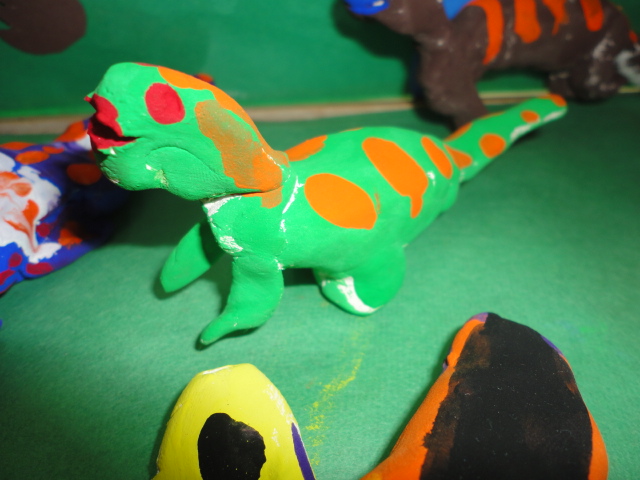
    2nd Grade Clay Dinosaurs

     It's that time of year again- CLAY TIME! I like to have a variety of 2D & 3D projects in the art show so I like to wait until spring to do many clay projects. This is the third year for 2nd grade to make clay dinosaurs. I think they've come out wonderful again.

    This lesson is a nice step up for the clay skills of young students. In first grade, they make a pinch-pot based sculpture, so in second grade, I focus on attaching clay together by scoring and smoothing. This lesson could be easily adapted for nearly any subject matter and still teach the same skills. 

    A cool part of the display for these dinosaurs is the background. Last year, I cut some blank green mountains to fit the display space and laminated them. Kids who finish early can add background elements they make out of scrap construction paper. It adds a little environment to the display that really helps make the dinosaurs pop!

    Click here to download my lesson plan!


    Monday, May 20, 2013

    2nd Grade Eric Carle Butterflies

    Getting caught up on blogging requires a lot of posts sometimes. Today may be a three post day! 

    This is a project that was hung in the art show a couple of weeks ago. It wound up being a crowd favorite. The project was based on the artistic style of Eric Carle. My 2nd grade students copied Carle's style by making textured/patterned papers. Each student created two textured pieces using tempera paint and a wide variety of non-traditional painting tools. 

    After the papers were created, one was folded and a basic butterfly shape cut out of it. Students used their other textured page along with construction paper scraps to make symmetrical designs on their butterfly wings. The final product was mounted on black or white construction paper and cut out a final time to give the butterfly a nice border. 

    Friday, April 12, 2013

    2nd Grade Clay Dinosaurs


    Spring is clay time at Thomas Elementary. I like to have several ceramic projects in the spring art show and I don't have anywhere to store hundreds of dinosaurs, bugs, castles, and coil pots. (I really do come off like a male teacher when I look at those topics!) 

    I haven't done this project in a couple of years because of having student teachers so I was happy to get back to it. First grade always does a pinch pot based project, so this lesson adds new ceramic skills. The main artistic point of this project is the idea of scoring clay to attach two pieces together. At this point, you may be asking yourself, "Self, why isn't he having those nice children use slip?" To that I'd say, "Slip is totally unnecessary in an elementary classroom." I like to try to minimize potential reasons for unnecessary mess and time consumption. As long as the parts are scored correctly, all they need is a drop or two of water and a little smoothing around the edges to attach. 

    The backgrounds are just a bonus on this project. I'm probably a little too careful with firing my clay pieces. I like to give them at least a week to dry out, so I always have a little mini lesson in between finishing the clay and painting or glazing. For this lesson, I had kids make a couple of background elements. I just choose a dozen or so from each class to attach to the "mountains" that I made out of craft paper and laminated for later use.