I think Instagram has surpassed Pinterest in usefulness for me. Since Pinterest keeps adding pins of things THEY think will be interesting to me and things that THEY think I'll want to buy, half my feed is essentially junk. Conversely, there are a lot of art teachers who post relevant, real life lessons, ideas, and observations on Instagram daily. I've gotten a good amount of new lesson ideas this year from Instagram and I've had great success with them. If you want frequent updates from my classroom, follow me on Instagram @thomas_elementary_art
One Instagram post by another teacher (@mrsallainart) inspired this new first grade clay lesson. I always base my first grade ceramics project on the pinch pot. This project included a wide, shallow pinch pot as well as a simple penguin. Penguin details (wings & beak) were added by simply smoothing clay together. The penguins were scored to attach to the base. The sculpture portion was pretty fun and not too difficult for my first graders, but the killer part of the lesson was the ice.
I bisque fired the penguins after they had been sculpted. I then added several blue decorative glass marble type things to the base of each penguin. I got the glass from the dollar store. They're not perfectly round, but I would imagine real marbles or even small pieces of other types of glass would work just fine. I re-fired at cone 05 and achieved this sweet ice effect. The glass melted very nicely. I just recommend that you put plenty of glass in. I wound up adding more glass and re-firing the first set that I tried because they needed more glass to cover the bottom.
This project was a big hit with the first graders and everyone up through 5th grade was super jealous that they didn't get to make one. I guess that's one way of knowing a lesson was successful.
Showing posts with label animals. Show all posts
Monday, June 6, 2016
Wednesday, January 6, 2016
3rd Grade Charley Harper Inspired Cardinals
Stop! Harper time!
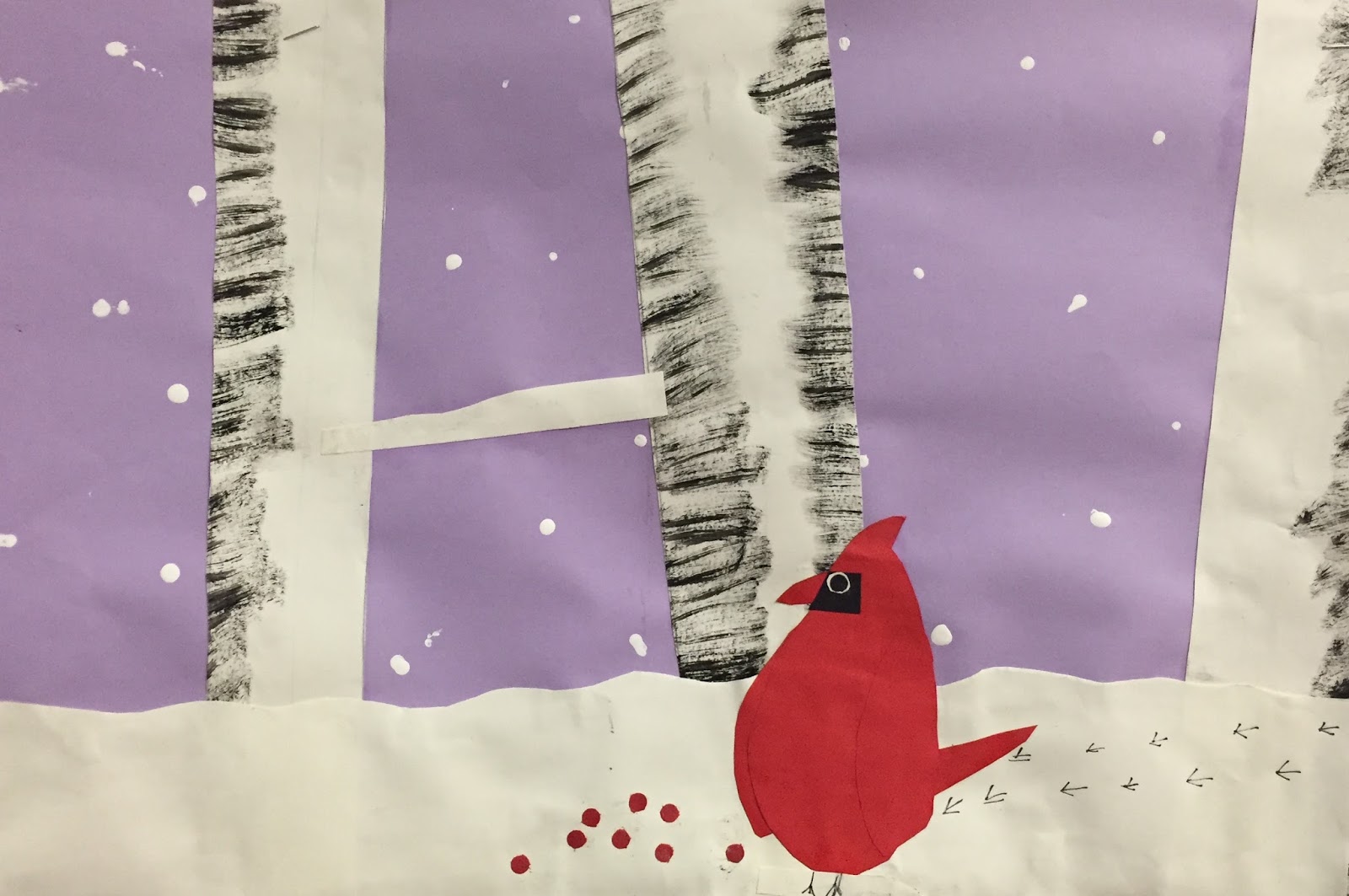
Wow. That was super lame. It did make me chuckle, though. It's also true. Right before winter break is when I typically have my 3rd graders study the work of Charley Harper. The outcome is a lesson that forces students to think and create art in a new way. It also looks pretty wintery and makes for a great display.
This lesson is all about Charley Harper, an artist who lived in Ohio the majority of his life. If you're familiar with his work, you know that he uses flat, graphic shapes to create mainly images of wildlife. As my school is in Ohio, I have students all make cardinals. I don't like limiting a project that much, but it works out in this case for a couple of reasons. First, there are limitless ways to create a cardinal out of flat, graphic shapes. No two students create identical cardinals. It also gives me the opportunity to display quite a few reference pictures, so students can get a really good grasp on what they are creating.
I have students start with about 30 minutes of small sketches. I usually have students draw quite a bit before they begin a final project and it results in more thoughtful work. Students then select their favorite sketch and use construction paper to recreate it. They then create a background. More choice is included in making the background. I demonstrate how to make trees (using a dry brush technique), how to make snowflakes (using white paint and the handle of a brush), snow drifts, berries, and bird footprints. Students chose to use any or all of those ideas to make their own background. As has been the case before, the results of this lesson are super successful.
Download the lesson plan for this project here!
Wow. That was super lame. It did make me chuckle, though. It's also true. Right before winter break is when I typically have my 3rd graders study the work of Charley Harper. The outcome is a lesson that forces students to think and create art in a new way. It also looks pretty wintery and makes for a great display.
This lesson is all about Charley Harper, an artist who lived in Ohio the majority of his life. If you're familiar with his work, you know that he uses flat, graphic shapes to create mainly images of wildlife. As my school is in Ohio, I have students all make cardinals. I don't like limiting a project that much, but it works out in this case for a couple of reasons. First, there are limitless ways to create a cardinal out of flat, graphic shapes. No two students create identical cardinals. It also gives me the opportunity to display quite a few reference pictures, so students can get a really good grasp on what they are creating.
I have students start with about 30 minutes of small sketches. I usually have students draw quite a bit before they begin a final project and it results in more thoughtful work. Students then select their favorite sketch and use construction paper to recreate it. They then create a background. More choice is included in making the background. I demonstrate how to make trees (using a dry brush technique), how to make snowflakes (using white paint and the handle of a brush), snow drifts, berries, and bird footprints. Students chose to use any or all of those ideas to make their own background. As has been the case before, the results of this lesson are super successful.
Download the lesson plan for this project here!
Monday, July 27, 2015
4th Grade Reduction Prints
This project is like magic. The first year I did it, I was absolutely astonished at how well it turned out. It is still my favorite printmaking project that I teach. I usually post 4-8 examples of each project and every year I find myself posting WAY more than that for this lesson. It's just that good.
I have visual instructions for this project on my original post of this project. The concept here is that students start with a large piece of foam and press in details to print one step at a time. The inks are layered and students eventually wind up with a three color print.
Andy Warhol is the major inspiration for the lesson. We take a look at various example and talk about how screen printing was Warhol's primary method of art making. It gives the students a good jumping-off point for the lesson.
Also, before you ask, we use photo reference for the animal drawings. I get a huge stack of animal books from the library and students choose a specific photo or two to draw from. I get way more detailed and realistic work from students this way.
Enjoy the examples from this year!
Click here to download my lesson plan.
I have visual instructions for this project on my original post of this project. The concept here is that students start with a large piece of foam and press in details to print one step at a time. The inks are layered and students eventually wind up with a three color print.
Andy Warhol is the major inspiration for the lesson. We take a look at various example and talk about how screen printing was Warhol's primary method of art making. It gives the students a good jumping-off point for the lesson.
Also, before you ask, we use photo reference for the animal drawings. I get a huge stack of animal books from the library and students choose a specific photo or two to draw from. I get way more detailed and realistic work from students this way.
Enjoy the examples from this year!
Click here to download my lesson plan.
Monday, July 20, 2015
3rd Grade 3D Paper Landscapes
I love it when a plan comes together. Sometimes it doesn't. That's fine, too.
This lesson originated as an amalgamation of two projects I've taught to 3rd grade in the past. One of my goals was to create more 3D lessons this year. This was my attempt for 3rd grade.
Essentially what I wanted to do was have a paper landscape with individual pieces created for the foreground, middle ground, and background. The landscape would depict the habitat of an animal that would also be included in the work. The landscape elements would be combined with two accordion-like edges, and a little paper frame would finish the front. It would look something like this quick demo piece I did.
The project went great. Then I demonstrated how to put the whole thing together. That's when I got the dreaded look of confusion from most of the class. I knew the way I had it planned was going to be kind of difficult, so I had my demonstration broken down pretty well. I was using a document camera and my projector to project my demo on the big screen so everyone could see. We worked step by step. A few kids got it, but it was mass confusion for the rest. Needless to say, I changed things the next day.
I ended up making little springs out of 1x3 strips of card stock and having students attach attach several in between layers of their landscape. I still really like how the project turned out and it was MUCH simpler to teach to my other four classes.
Subscribe to:
Comments (Atom)