Instagram

Tuesday, November 17, 2015

Hundertwasser Inspired Abstract Tree Sculptures by 2nd Grade

I like to set goals for myself for each school year. They are usually based around what I'm going to teach in a given year. This year, my goal is to write a sculpture lesson plan for each grade level. I have really nice display shelving that I fear goes unused for much of the year simply because of the fact that I like to save most of my ceramic work for the art show in the spring. 

This lesson is the first part of my goal coming to fruition. The basic idea came from a blogger I found through Pinterest. I adapted the artwork that her students created and re-worked the artist inspiration to match some other ideas that were rumbling around in my head. 
The artist I used to inspire the lesson is the multi-talented Austrian artist Friedensreich Hundertwasser. If you don't know this guy, look him up. He's a complete trip. I like his paintings, but his architecture is amazing. During class, we talked about his use of organic lines, bright colors, and his passion for environmentalism. We then created tree sculptures made almost entirely from recycled materials. 


Hundertwasser has many paintings featuring trees that look strikingly similar to lollipops  We took the idea of lollipop trees and made trees with lollipop leaves. The trees were made from poster board scraps, newspaper, scrap construction paper, a little Modge Podge, and a bit of glue. We thought it was pretty funny that we were making recycled art trees out of paper that originally came from trees. I think we completed some sort of environmental circle with this lesson. Either way, it was a super successful lesson and a great learning experience for my 2nd graders!

Click here to download my lesson plan!


Friday, November 13, 2015

5th Grade Personal Logos

Most of the lessons in 5th grade revolve around careers in the art field. When I was in elementary school, I don't think that I truly understood that all artists weren't just professional fine artists. After graduating from art school, I now know how many careers relate directly to visual art. I want my students understand that. 

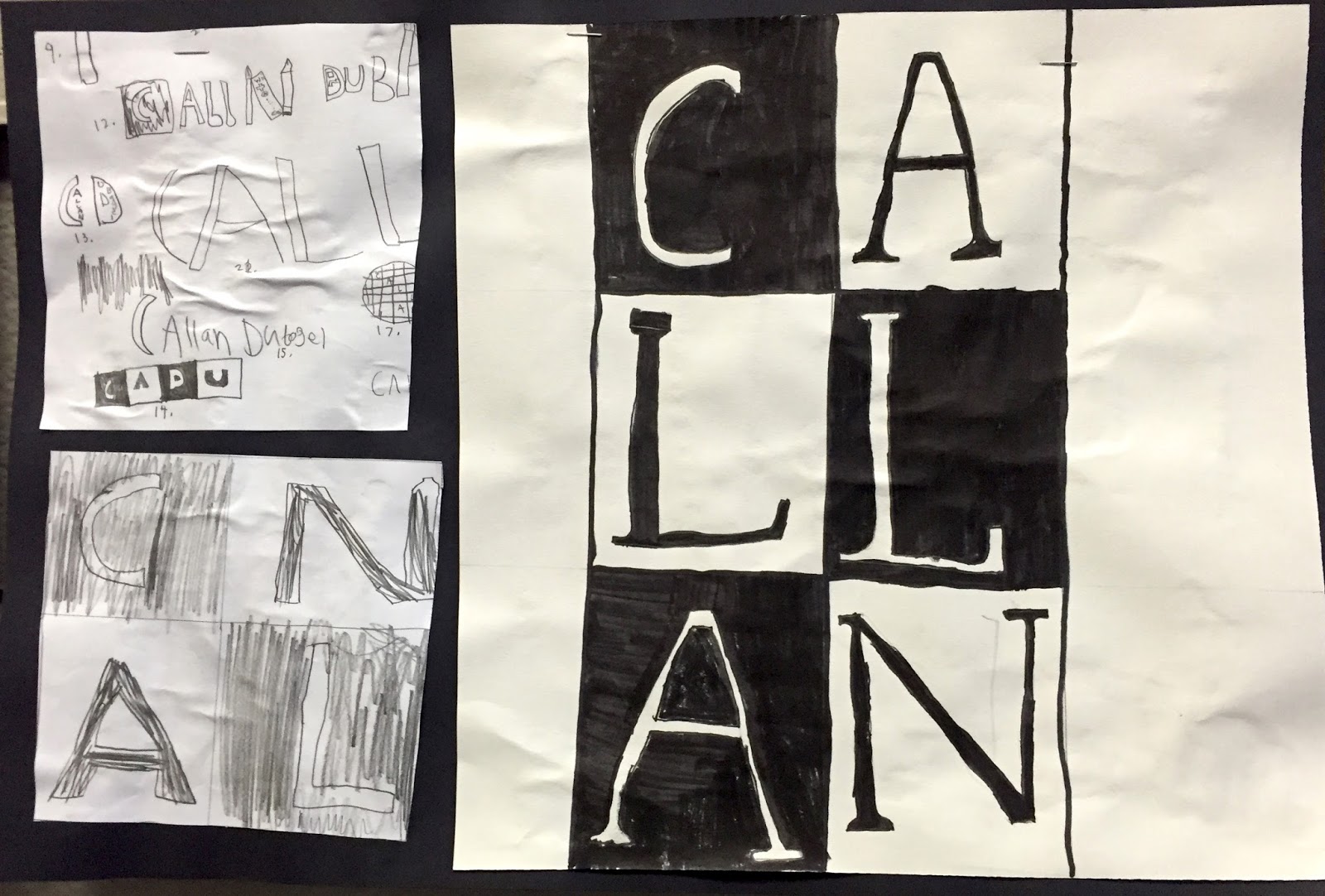
The first project for 5th grade this year is based on the career of a graphic designer. Students were asked to design a logo that represents themselves. We really dove into a lot of professional examples and dissected them to figure out what makes a good logo work. We spent a lot of time on thumbnail sketches. A lot of time. Most students 20+ thumbnail sketches. After a couple rounds of peer review, students created two second drafts, then eventually made a large version of the final logo. 

I really like this project because it allows students to demonstrate their thinking throughout the entire design process. The final work is mounted along with the thumbnail sketch and second draft that most closely resemble the final logo. The final work turns out very nice and it allows me to get to know my students a little better. 

Click here to download my lesson plan!

This student enjoys hunting. What a well done logo!


Wednesday, October 28, 2015

Totem Poles by 4th Grade

This is a project that I just can't quit. I've been doing it for several years now and the work just keeps getting better every year. Sometimes I wonder if readers get bored with seeing some of the same projects each year. Looking at these totems, who could get bored? 

One of the things I like best about this lesson is that it's hard. It's really hard for some kids. Good. The most difficult aspect of the lesson is drawing an animal in such a way that it looks like it has been carved into a totem pole. Negative space is essentially nonexistent. I tell my students that they need to use about 98% of their paper. It really forces students to entirely re-think the way they have drawn animals for their entire lives. It makes them learn!

I've been dealing with combined classes with 4th grade this year and I was initially concerned that it would negatively impact the quality of student work. For this project, it absolutely didn't. Students have produced more high level work this year than any previous year. The stress of teaching 34 kids at once has apparently paid off. Enjoy the work! 


Wow.


Tuesday, October 20, 2015

Creative Play

Creativity. One might think it's automatically a part of all art rooms. I don't agree. To me, creativity is tied closely with choice and critical thinking. In following many art ed blogs and Instagram feeds, I see plenty of lessons in which every child's art LOOKS THE SAME. To me, that doesn't teach creativity. I'm not entirely sure it teaches art. I apologize if this is reflective of your style of teaching. It's just not mine. 

Over the summer, I attended the "Teaching for Creativity Institute" at the Columbus Museum of Art. As an educator, I've been studying creativity along with my elementary art colleagues in my district. I learned quite a bit at the institute, but I learned just as much simply being in the museum. CMA has done some major renovations and additions recently. One of the renovated areas was the kid's area of the museum. It was absolutely filled with items for creative play. This was something I wanted to include in my classroom this year. 
I spent quite a bit of time researching different creative play toys. I wound up purchasing about eight different kinds of materials specifically for creative play. I started the year with only some plain wooden blocks. They were on my list to purchase, but another teacher wanted to get rid of them! Score! I explained to my classes that the blocks would be available to use for early finishers. I assumed they would go over with the younger kids, but I wondered if the older kids would be too cool for wooden blocks. Quite the opposite happened. Every single student wants to play with the blocks. The variety of creative uses for the blocks is astounding. 

Open ended creative play is largely missing in schools today. Kids no longer get to just be kids. Creative play gives students the ability to make their own choices in what they make. They are only limited by their imagination. Since I introduced these creative play options, very few students choose to do free drawing if they finish early. I love seeing the enthusiasm for creativity. 

What do you do to allow creative play in your classroom? I'd love to know!


Thursday, October 1, 2015

In Process

The beginning of this year (even though I'm 6 weeks in) has been busy. The beginning is always busy, but this year has been exceptionally busy. There's a lot of "stuff" going on in addition to teaching. 

My class sizes are bigger than ever. I get a 4th grade class and a quarter each morning first thing. 33-34 kids. I'm just going to leave that one out there. 

I was asked to write an article about my printmaking lessons by Arts & Activities magazine. I was also asked to contribute to a book of elementary art lesson plans. Both of these opportunities are super exciting, but definitely did add to my workload. 

Of course starting new lessons with all five grade levels simultaneously is always a challenge as well. Since many of those projects haven't been finished yet, I thought I'd post a few pictures of things going on around Thomas just to prove that I haven't dropped entirely off the earth.

During my first rotation, I had every single student create a small self portrait and write three goals for the school year. I like that I was able to get a display up relatively quickly and get the students right into art making at the beginning of the year. Each grade level used a specific color in order to create the rainbow effect with the display. 

Photographing printmaking examples for Arts & Activities magazine. 
 
Nope, not crowded at all!

 My school district has rethought the gifted model for this year and there is a strong emphasis on the six habits or practices of thinkers. It really fits into what art teachers do every day, so I'm excited to see a district-wide emphasis on creativity and critical thinking. I designed this sweet poster that is now in every classroom in my building. 

 Another change this year is adding more options for students for free creativity time when they finish a project early. The blocks are a huge hit. There will be more options soon!


Wednesday, September 9, 2015

Wait! I'm more than just a teacher!

I know it sounds like crazy talk, but most teachers do actually have a life and interests that aren't school related. Summer is a great time to indulge those interests. Over two years ago, I designed a dining room table with the intent of building it that summer. My daughter was an infant that summer. Needless to say, I didn't have time to build a table. Last summer, time again slipped away from me and my plans gathered more dust. This summer was do or die. I did!

From a design standpoint, I like to combine clean, modern lines with older elements. This is how my finished table came out! 
The table top is made of 8/4 ash. I designed the base and had it fabricated by a local iron working company. The top has old letterpress typography inset and covered with glass. My wife is a graphic designer is a slight obsession with typography. I love the history behind it and being able to think about what the letters have been used to print throughout the decades. 

I'm really happy with how the whole project came out. I'm even happier that I found time to build it. 

Close-up of the type inset. It was slightly terrifying taking a router
to a perfectly good tabletop. Everything wound up fitting perfectly.
Detail of the base. Much of the type is lead,
so the top needed a good amount of support.